Lily's Kitchen Small Breed Chicken vs Pooch & Mutt Adult Chicken
Side-by-side comparison of scores, ingredients, prices and real customer feedback for Lily's Kitchen Small Breed Chicken and Pooch & Mutt Adult Chicken.
Last verified: 17 Jun 2026 · Based on 25 reviews
Lily's Kitchen Small Breed Chicken scores 81.0/100 vs Pooch & Mutt Adult Chicken at 79.0/100. Lily's Kitchen Small Breed Chicken wins on ingredient quality, nutritional value, palatability. Pooch & Mutt Adult Chicken is stronger on value for money and transparency.
How Do the Scores Compare?
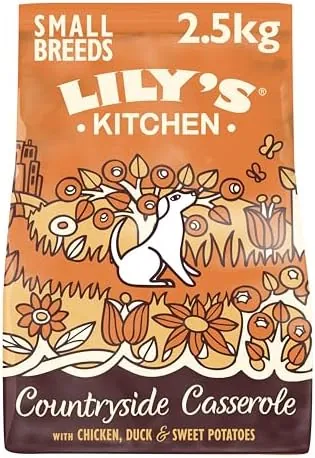
Lily's Kitchen Made with Na...
Lily's Kitchen
|
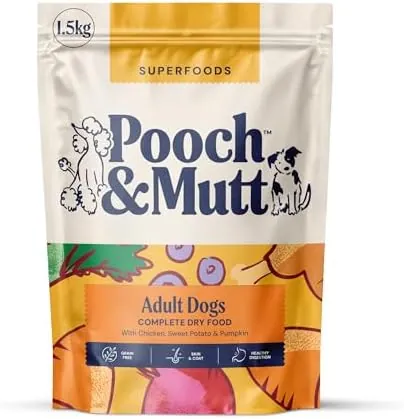
Pooch & Mutt - Adult Superf...
Pooch & Mu
|
|
|---|---|---|
| Overall Score | 81.0 | 79.0 |
| Ingredient Quality |
87.0/100
Best
|
80.0/100 |
| Nutritional Value |
80.0/100
Best
|
78.0/100 |
| Value for Money | 62.0/100 |
76.0/100
Best
|
| Transparency | 85.0/100 |
89.0/100
Best
|
| Palatability |
88.0/100
Best
|
74.0/100 |
| Best Price | £19.49 Amazon UK → |
£7.40
Amazon UK →
Cheapest
|
| Form | ||
| Dose | ||
| Third-Party Tested | ✗ No | ✗ No |
| Reviews Analysed | 12 | 13 |
Lily's Kitchen Made with Natural...
Pros
- ✓High fresh meat content — 31% chicken and 8% duck, both clearly named and freshly prepared
- ✓No meat by-products, meat meal, or vague 'animal derivatives' — full ingredient transparency
- ✓Small kibble size purpose-built for small breeds, reducing choking risk and improving chewing
- ✓Excellent palatability across reviews including fussy eaters and dogs with sensitive stomachs
Cons
- ✗Premium price point — significantly more expensive per kg than mainstream dry dog foods
- ✗Grain-free formulation: ongoing FDA/WSAVA debate around legume-heavy diets and dilated cardiomyopathy (DCM), though evidence is strongest in large breeds
- ✗Packaging confusion noted by reviewers — small breed and adult ranges look very similar
- ✗One reviewer's small dog did not accept it, confirming palatability is not universal
Best For
Pooch & Mutt - Adult Superfood C...
Pros
- ✓Chicken Protein at 30% as the first ingredient, with no by-products or generic meat meal
- ✓Full percentage breakdown for every ingredient — transparency well above category average
- ✓Salmon Oil, Linseed and Microalgae Oil supply omega-3 fatty acids including DHA
- ✓Several owners report no digestive upset, with one fussy dog with allergies eating it without a flare-up
Cons
- ✗A few reviewers' dogs refused the food, so palatability isn't universal
- ✗Potatoes, Sweet Potatoes (17%) and Chickpeas (6%) make this a carb-heavy grain-free base
- ✗Several superfoods (spinach, kale, rosehips, pomegranate) are dosed at just 0.05%, more decorative than functional
- ✗One reviewer flagged that the newer bag is hard to tear open and needs scissors
Best For
Score Breakdown: Lily's Kitchen Small Breed Chicken vs Pooch & Mutt Adult Chicken
Lily's Kitchen Small Breed Grain-Free Chicken & Duck is a premium dry kibble built around 39% named fresh meat (31% chicken, 8% duck), with no by-products or meat meals — a standout for ingredient transparency in the mass-market segment.
What are the key differences?
Frequently Asked Questions
Which is better, Lily's Kitchen Small Breed Chicken or Pooch & Mutt Adult Chicken? ▼
Is Lily's Kitchen Small Breed Chicken worth the price compared to Pooch & Mutt Adult Chicken? ▼
Which has fewer side effects? ▼
Related Product Comparisons
Complete Natural Adult Dog Food Wet (10 x 150g Trays)
vs Lily's Kitchen Made with Natural Ingredients Adult Small Breed Dry Dog Food Chicken & Duck Grain-Free Recipe 2.5kg
Complete Natural Adult Dog Food Wet (10 x 150g Trays)
vs Pooch & Mutt - Adult Superfood Complete Dry Dog Food Grain Free (Regular Sized Kibble), Chicken, 1.5kg
Lily's Kitchen Made with Natural Ingredients Adult Small Breed Dry Dog Food Chicken & Duck Grain-Free Recipe 2.5kg
vs Lily's Kitchen Natural Adult Wet Dog Food Tray Cottage Pie Grain-Free Recipe 10 x 150g
Lily's Kitchen Made with Natural Ingredients Adult Small Breed Dry Dog Food Chicken & Duck Grain-Free Recipe 2.5kg
vs Pooch & Mutt - Health & Digestion, Complete Dry Dog Food (Grain Free), Salmon and Sweet Potato, 2kg
Lily's Kitchen Made with Natural Ingredients Adult Small Breed Dry Dog Food Chicken & Duck Grain-Free Recipe 2.5kg
vs Lily's Kitchen Natural Adult Wet Dog Food Tins Classic Dinners Variety Pack 6 x 400g & Natural Adult Wet Dog Food Tins Grain-Free Recipe Variety Pack 6 x 400g
Lily's Kitchen Made with Natural Ingredients Adult Small Breed Dry Dog Food Chicken & Duck Grain-Free Recipe 2.5kg
vs Burns Pet Nutrition Sensitive Grain Free Duck and Potato Adult Dry Dog Food, 2 kg
What the Data Says
Is grain-free dog food actually better? What the data shows.
Grain-free leads on every metric, but the gap is smaller than marketing suggests. We scored 27 grain-free and 73 standard dry dog foods across the same criteria.
The numbers: grain-free averages 75.1/100 overall versus 71.5 for standard — a 3.6-point lead. Break it down by category and the picture gets more interesting.
Ingredient quality is where grain-free pulls ahead most: 77.8 versus 71.2, a 6.6-point gap. Grain-free brands tend to use higher meat content and fewer cheap bulking agents. Transparency is the second-largest gap: 74.9 versus 69.8 (5.1 points) — grain-free brands are generally more upfront about sourcing and ingredient percentages.
But nutritional value tells a different story: 72.1 versus 70.0, just 2.1 points apart. That's the smallest gap of any metric. Removing grains doesn't automatically make a food more nutritious.
Bottom line: if your dog has a diagnosed grain intolerance, grain-free is the right call. If not, a high-scoring standard food delivers nearly identical nutrition at a lower price point.
Do grain-free dog foods hide carbohydrate fillers?
Grain-free scores better on transparency (74.9 vs 69.8), but grain-free does not mean low-carb. That 5.1-point transparency gap across 27 grain-free and 73 standard products means grain-free brands are more likely to disclose ingredient percentages and sourcing details.
The catch: most grain-free formulas replace rice, wheat, or corn with peas, lentils, chickpeas, or sweet potato. These are still carbohydrate sources. Some grain-free products list two or three legume variants in the first five ingredients, pushing total carbohydrate content to 40-50% of the formula.
Here's how to check: read the analytical constituents on the back of the bag. If protein is 25% and fat is 15%, the remaining 60% is mostly carbohydrates, moisture, and fibre. That's true whether the carbs come from brown rice or sweet potato.
The grain-free label tells you what's absent, not what replaced it. Higher transparency scores mean these brands make it easier for you to verify the substitution yourself — but you still need to look.
Disclaimer: AIScored provides data-driven comparisons based on publicly available reviews. This is not medical advice. Affiliate links may earn us a commission at no extra cost to you.
Feedback & Suggestions
Spotted an issue? Wrong price, incorrect data, or something else off? Let us know and we'll fix it.
Missing a product you'd like us to review? Tell us the product name and we'll consider adding it.