Nutricost Creatine Monohydrate vs Applied Nutrition Creatine Icy Blue Raz
Ad: we earn a commission if you buy through links on this page. It never affects our scores or rankings. How we make money
Side-by-side comparison of scores, ingredients, prices and real customer feedback for Nutricost Creatine Monohydrate and Applied Nutrition Creatine Icy Blue Raz.
Last verified: 19 Oct 2026 · Based on 25 reviews
Nutricost Creatine Monohydrate scores 72.0/100 vs Applied Nutrition Creatine Icy Blue Raz at 71.0/100. Nutricost Creatine Monohydrate wins on ingredient quality, value for money. Applied Nutrition Creatine Icy Blue Raz is stronger on effectiveness and side effects.
How Do the Scores Compare?
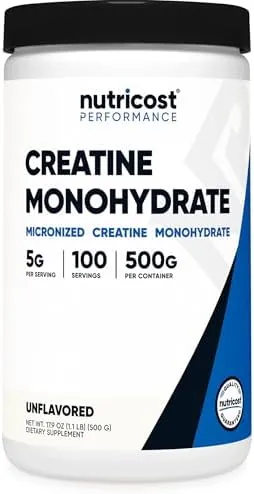
Nutricost Creatine Monohydr...
Nutricost
|

Creatine Monohydrate Icy Bl...
Applied Nutrition
|
|
|---|---|---|
| Overall Score | 72.0 | 71.0 |
| Effectiveness | 78.0/100 |
79.0/100
Best
|
| Ingredient Quality |
76.0/100
Best
|
72.0/100 |
| Value for Money |
84.0/100
Best
|
70.0/100 |
| Side Effects | 70.0/100 |
86.0/100
Best
|
| Certifications | 30.0/100 |
35.0/100
Best
|
| Best Price | £19.95 Amazon UK → |
£11.00
Amazon UK →
Cheapest
|
| Price per Serving |
£0.20
100 servings
Best value
|
£0.22 50 servings |
| Form | Powder | Powder |
| Dose | 1.1 Pounds | N/A |
| Third-Party Tested | Maker’s claim | ✗ No |
| Reviews Analysed | 12 | 13 |
Nutricost Creatine Monohydrate M...
Pros
- ✓Clinically standard 5g creatine monohydrate per serving
- ✓Good value: 100 servings per 500g tub, and two reviewers praise the price-to-quality ratio
- ✓Unflavoured, which one reviewer says makes it perfect for adding to protein shakes
- ✓One reviewer who has used it for 4 months is fully satisfied, and another noticed a difference
Cons
- ✗Two reviewers say it doesn't dissolve well, and one compares the texture to 'plastic dust'
- ✗One reviewer says it gave them a headache even when they drank plenty of water, and that friends who tried it got headaches too
- ✗No named third-party certification is confirmed in the product specs
- ✗The marketing copy ('unlock your superpower') overstates what is a basic, standard creatine
Best For
Creatine Monohydrate Icy Blue Raz 250g
Pros
- ✓Flavour well-received — raspberry taste makes daily dosing more enjoyable than unflavoured alternatives
- ✓Dissolves easily in most liquids including cold coffee, per multiple reviewers
- ✓4.25g dose exceeds the 3g EU health claim threshold for high-intensity exercise performance
- ✓Creatine monohydrate is the most researched form with decades of safety and efficacy data
Cons
- ✗Serving count discrepancy reported — at least one buyer measured ~40 servings rather than the label claim of 50
- ✗Gritty texture in cold water noted by one reviewer; may clump if not fully dissolved
- ✗No third-party testing or certification (Informed Sport, NSF) disclosed
- ✗Oversized tub relative to fill level flagged as wasteful packaging
Best For
Score Breakdown: Nutricost Creatine Monohydrate vs Applied Nutrition Creatine Icy Blue Raz
This is plain micronised creatine monohydrate: 5000mg (5g) per scoop and 100 servings in a 500g tub.
What are the key differences?
Frequently Asked Questions
Which is better, Nutricost Creatine Monohydrate or Applied Nutrition Creatine Icy Blue Raz? ▼
Is Nutricost Creatine Monohydrate worth the price compared to Applied Nutrition Creatine Icy Blue Raz? ▼
Which has fewer side effects? ▼
Related Product Comparisons
Bulk Creatine Monohydrate (Creapure) 500g
vs Nutricost Creatine Monohydrate Micronized Powder 500G, 5000mg Per Serv (5g) - 100 Servings for Endurance, Muscle Growth, Athletic Performance and Recovery
Bulk Creatine Monohydrate (Creapure) 500g
vs Creatine Monohydrate Icy Blue Raz 250g
Dymatize Creatine Micronized 500g
vs Nutricost Creatine Monohydrate Micronized Powder 500G, 5000mg Per Serv (5g) - 100 Servings for Endurance, Muscle Growth, Athletic Performance and Recovery
Dymatize Creatine Micronized 500g
vs Creatine Monohydrate Icy Blue Raz 250g
Platinum Creatine Plus Orange 350g
vs Nutricost Creatine Monohydrate Micronized Powder 500G, 5000mg Per Serv (5g) - 100 Servings for Endurance, Muscle Growth, Athletic Performance and Recovery
Platinum Creatine Plus Orange 350g
vs Creatine Monohydrate Icy Blue Raz 250g
What the Data Says
Why do 87% of UK creatine products lack third-party certification?
87% of UK creatine products have zero independent certification. Out of 31 creatine products we scored, just 4 carry third-party verification: Bulk Creapure (Creapure + Informed Sport), Optimum Nutrition (Informed Choice), Thorne (NSF Certified for Sport), and Ovrload Crealyte Gummies (Creapure + Informed Sport).
The quality gap is real. Certified creatine scores 77.2/100 on average. Uncertified creatine scores 67.5. That's a 9.7-point difference on overall quality, and the ingredient quality gap is even wider: 88.5 vs 70.9.
Why so few? Third-party testing costs money, and UK regulations don't require it for sports supplements. Brands that invest in certification tend to use higher-grade raw materials too. Bulk Creapure, our top-scoring creatine at 91/100, uses Creapure-branded monohydrate manufactured in Germany with documented purity testing. Most budget creatine powders don't disclose where their creatine comes from or whether it's been independently verified.
If purity matters to you, look for one of these four certifications on the label: Creapure, Informed Sport, Informed Choice, or NSF Certified for Sport.
Is creatine monohydrate better than HCL or other forms?
Monohydrate wins. The top 5 creatine products in our database are all monohydrate-based, led by Bulk Creapure at 91/100. That's not a coincidence.
Creatine monohydrate has decades of clinical research behind it. Over 500 published studies confirm its effects on muscle strength, power output, and recovery. HCL, ethyl ester, and buffered forms have far less evidence, and none have been shown to outperform monohydrate in head-to-head trials.
The 'better absorption' claim for HCL sounds compelling, but there's limited independent data to support it at the doses you'd actually take. Monohydrate is also the cheapest form by a wide margin.
The bloating concern with monohydrate is real for some people, but it's usually a loading-phase issue. Starting at 3-5g daily (no loading phase) avoids it for most users.
Disclaimer: AIScored provides data-driven comparisons based on publicly available reviews. This is not medical advice. Affiliate links may earn us a commission at no extra cost to you.
Feedback & Suggestions
Spotted an issue? Wrong price, incorrect data, or something else off? Let us know and we'll fix it.
Missing a product you'd like us to review? Tell us the product name and we'll consider adding it.